When Batman v Superman: Dawn of Justice opened in theaters in March 2016, audiences saw a movie running roughly two and a half hours.
A few months later, Warner Bros. released a significantly longer version.
It ran just over three hours.
And it did more than restore a handful of deleted scenes.
Those additional minutes change the way several storylines are understood — especially those involving Lois Lane, Clark Kent, Lex Luthor and the events in Nairomi.
That version was released as:
Batman v Superman: Dawn of Justice — Ultimate Edition.
But why does it exist?
And was it really created in response to the criticism the theatrical cut received?
The chronology tells a more complicated story.
Two major versions of the same film
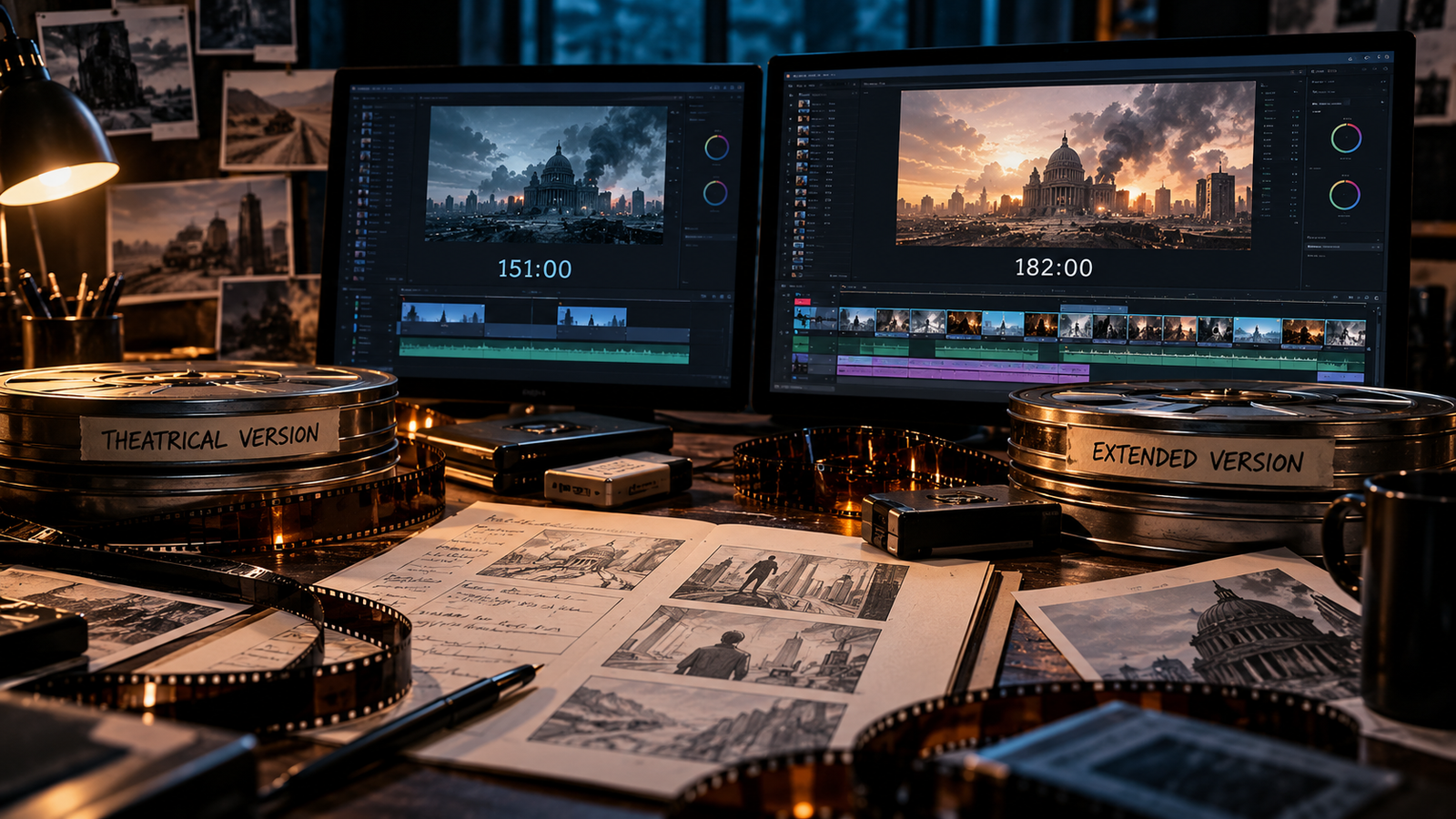
The theatrical version runs approximately 151 minutes.
The Ultimate Edition runs approximately 182 minutes.
That is a difference of about 31 minutes.
For an already dense movie, half an hour is significant.
Those additional scenes can affect:
the rhythm of the story;
the motivations of the characters;
the connections between different plotlines;
and the way one event leads into another.
But one misconception should be corrected immediately.
The Ultimate Edition was not created after the theatrical release received negative reviews.
Its existence was already public before the movie opened in U.S. theaters.
The longer cut was known before the theatrical release
Batman v Superman opened in the United States on March 25, 2016.
But the American ratings bulletin published on February 24, 2016 already listed a version called the Ultimate Edition.
That version had received an R rating for sequences of violence.
The theatrical version, meanwhile, carried a PG-13 rating.
The same ratings documentation indicates that the PG-13 version had already been classified months earlier, in September 2015.
That chronology matters.
The Ultimate Edition therefore cannot have been created as a reaction to reviews of the theatrical release.
A separate, longer version had already been identified and classified before the public release.
So why was the movie shortened for theaters?
A three-hour blockbuster creates practical concerns for theatrical distribution.
Longer movies mean fewer possible screenings per auditorium each day.
They also represent a greater time commitment for a very broad mainstream audience.
But we need to distinguish clearly between different accounts of what happened.
Zack Snyder explained around the time of release that he and the studio had been looking for a theatrical length that was more workable, and that once the film moved beyond roughly two and a half hours, its runtime became a concern.
He also indicated that some material was removed for ratings-related reasons.
Years later, screenwriter Chris Terrio described the process more critically.
According to Terrio, Warner wanted roughly thirty minutes removed from the movie, and some of the deleted material contained information necessary to understand the motivations driving the climax.
Those are two perspectives on the same editing process.
They should not be collapsed into a single definitive explanation.
The thirty minutes were not simply decorative
That distinction matters because many of the restored scenes are not merely atmospheric.
Some explain how characters reach conclusions that the theatrical version still shows them acting upon.
Remove the process, and the action remains.
But the reasoning becomes shorter.
Sometimes much shorter.
That is one of the central differences between the two cuts.
Nairomi becomes much clearer
Early in the film, Lois Lane is in the fictional African country of Nairomi.
The theatrical cut shows Superman’s intervention and the political consequences that follow.
But several stages of the underlying plot are compressed.
The Ultimate Edition makes the setup far more explicit.
It gives Lois more time to investigate what actually happened.
She examines evidence from the attack.
She follows the trail of the ammunition used there.
And she gradually uncovers signs that the event was manipulated in order to make Superman appear responsible for deaths he did not cause.
The incident therefore becomes less of an unexplained political accusation and more of an identifiable part of a larger scheme.
Kahina Ziri becomes a far more important character
Kahina Ziri is initially presented publicly as a witness to the Nairomi incident.
Her testimony helps fuel the political case against Superman.
In the theatrical version, much of the machinery behind that testimony remains unclear.
The Ultimate Edition changes that.
Kahina eventually admits to Senator Finch that she did not tell the truth and that Lex Luthor pressured her.
Her role therefore becomes part of the film’s broader theme of manipulated information.
What first looks like independent testimony is revealed to be another element in a carefully constructed narrative designed to shape public opinion.
That makes her storyline far more important than it appears in the shorter cut.
Lois Lane has a real investigation
This is probably one of the most significant differences.
In the Ultimate Edition, Lois does not simply move from one revelation to the next.
She investigates.
The ammunition recovered from Nairomi becomes a lead.
That lead sends her toward technical evidence.
Then toward intermediaries.
Then toward connections involving Lex.
The story becomes much more clearly structured around a journalist trying to dismantle an operation piece by piece.
The theatrical cut retains fragments of that storyline.
But enough of the connective tissue is missing that some discoveries feel more abrupt than they do in the longer version.
Jenet Klyburn restores an important step in Lois’s investigation
One character disappears completely from the theatrical cut.
Jenet Klyburn, played by Jena Malone.
She is a scientist who assists Lois in analyzing physical evidence connected to the Nairomi investigation.
Later, she also becomes relevant to the investigation surrounding Wallace Keefe.
Her role is not enormous.
But narratively, it performs a useful function.
She gives Lois another identifiable step between finding evidence and understanding what that evidence means.
Removing her does not destroy the storyline.
But it shortens the chain of reasoning.
Clark Kent gets an investigation of his own
The second major restoration involves Clark.
In the longer cut, Clark does not oppose Batman simply because the screenplay needs the two heroes to become enemies.
He investigates the vigilante as a journalist.
He goes to Gotham.
He talks to people.
He learns about the fear Batman creates.
He researches Batman’s practice of branding criminals.
He follows the consequences of what happens to those people afterward.
That gives much more weight to Clark’s opposition to Bruce.
His judgment is no longer based mainly on distant observation.
He has investigated Batman’s methods and seen what those methods mean for people living in Gotham.
The Ultimate Edition restores Clark Kent the journalist
That is an important distinction.
Clark is not just Superman wearing glasses between action scenes.
His work at the Daily Planet becomes part of the story.
Perry White does not particularly want him pursuing the Batman story.
Clark continues anyway.
That creates a useful structural parallel.
Bruce investigates Superman.
Lois investigates Nairomi.
Clark investigates Batman.
Meanwhile, Lex manipulates the information reaching all of them.
The Ultimate Edition makes that network much easier to see.
The film becomes less elliptical
That may be the simplest way to describe the difference between the two cuts.
The theatrical version is highly compressed.
It moves quickly from one event to another.
It often asks the audience to reconstruct the missing connections.
The Ultimate Edition restores more transitions and more cause-and-effect.
Someone discovers something.
That discovery leads to an action.
The action leads to another scene.
The story remains dense.
But it becomes less elliptical.
That does not mean every criticism of Batman v Superman disappears in the longer version.
The tone is the same.
The basic character choices remain the same.
The central conflict remains the same.
But several pieces of narrative logic become substantially more explicit.
Lex Luthor’s plan becomes easier to follow
Lex is involved in many of the film’s major events.
In the theatrical cut, however, some of the steps in his manipulation are so compressed that he can appear almost omniscient.
The Ultimate Edition restores more of the machinery.
Nairomi.
The ammunition.
Kahina.
The intermediaries.
The political consequences.
The evidence being tracked by Lois.
The way information is deliberately shaped.
The longer cut does not fundamentally reinvent Lex Luthor.
It makes the architecture of his plan easier to see.

The Capitol bombing also gains more context
The explosion at the U.S. Capitol is one of the film’s central events.
In the theatrical version, it happens with brutal suddenness.
The Ultimate Edition spends more time on what follows.
Lois continues investigating.
She discovers evidence suggesting that Wallace Keefe did not know he was going to die.
Jenet Klyburn then helps establish a material connection between Keefe’s wheelchair, the unusual ammunition from Nairomi and Lex.
The longer cut also gives more explanation for the way the device was constructed and concealed.
The event itself does not change.
But the mechanism behind it becomes much more understandable.

Not every restored scene has the same importance
This point matters.
Some additions are crucial to understanding the story.
Others primarily add:
context;
character reactions;
transitions;
atmosphere;
or a few more seconds of an existing sequence.
It would therefore be misleading to claim that every single restored minute is essential.
The Ultimate Edition works through accumulation.
One additional transition.
One extra investigative step.
One reaction scene.
One clearer connection.
Taken separately, some may seem minor.
Together, they make the film easier to follow.
The R rating does not mean the longer cut is mainly about violence
Because the Ultimate Edition received an R rating in the United States, it is easy to assume the longer version exists primarily to restore more violent material.
There are indeed some more explicit moments.
Certain action sequences contain additional violence.
But that is not what makes the Ultimate Edition dramatically different.
Its most important additions are often narrative.
More Clark Kent.
More Lois Lane.
More Kahina Ziri.
More explanation surrounding the Capitol bombing.
More connective tissue around Lex’s plan.
So the additional violence helps explain the R rating.
It does not by itself explain why many viewers find the longer version easier to understand.
Terrio later described the cuts in much harsher terms
In 2021, Chris Terrio publicly revisited the editing of Batman v Superman.
According to Terrio, the roughly thirty minutes removed for the theatrical cut included material necessary to understand some of the characters’ motivations leading into the climax.
In his account, cutting those scenes damaged the narrative mechanism of the film.
Those elements were later restored in the Ultimate Edition.
It is important to keep the attribution clear.
This is Terrio’s retrospective account of what happened.
It should not be presented as an uncontested statement of Warner Bros.’ intentions.
But his explanation is useful because it closely matches the kinds of scenes that were restored:
investigation;
motivation;
cause and effect;
and transitions between major events.
Warner later promoted the longer cut as more “story and action”
When Warner Bros. prepared the Ultimate Edition for home release in summer 2016, the studio promoted it as containing roughly 30 additional minutes of story and action not seen in theaters.
That wording is revealing.
Even Warner’s own marketing did not describe the longer version simply as a more violent cut.
The emphasis was on both:
story
and
action.
That distinction matches what is actually restored.
The theatrical cut and Ultimate Edition are both official releases
One phrase needs particular care.
The theatrical version should not be described as the “approved” Snyder version unless we can establish exactly what kind of creative approval is meant.
The safest description is factual:
the 151-minute version is the cut Warner Bros. officially distributed in theaters in 2016.
The Ultimate Edition is the longer version Warner subsequently released officially for home viewing.
Both are official releases.
They simply contain different amounts of material.
The Ultimate Edition is not the Justice League Snyder Cut
The two situations are sometimes grouped together because both involve Zack Snyder and competing versions of DC films.
But historically, they are very different.
With Batman v Superman:
Snyder directs the movie;
he remains through production;
a shorter theatrical cut is distributed;
and a longer official version is released afterward.
With Justice League, the situation becomes much more complicated.
Snyder leaves before postproduction is complete.
The theatrical film is extensively reworked.
Scenes are rewritten.
Additional material is shot.
The editing changes.
The music changes.
The structure changes.
Years later, Snyder returns to complete his own version of the project.
So the Ultimate Edition of Batman v Superman should not be treated as an early version of exactly the same phenomenon.
They involve two very different production histories.
So which version should you watch?
If the goal is to understand the film’s narrative with the greatest amount of context, the Ultimate Edition provides more information.
It develops Lois Lane’s investigation.
It restores Clark Kent’s journalism.
It makes the manipulation of Kahina Ziri clearer.
It gives more detail surrounding Wallace Keefe and the Capitol bombing.
And it exposes more of the mechanics behind Lex Luthor’s plan.
That does not turn Batman v Superman into a fundamentally different movie.
The tone remains.
The central choices remain.
Batman remains the same Batman.
Superman remains the same Superman.
Lex remains the same Lex.
Doomsday remains part of the climax.
But the story has more room to explain how its pieces fit together.
That is why our Snyderverse viewing-order guide uses the Ultimate Edition as the reference version of Batman v Superman.
But the larger crisis had nothing to do with runtime alone
When Batman v Superman reached theaters in March 2016, Warner Bros. had more to deal with than the existence of two cuts.
The studio also had to respond to the film’s reception.
The opening weekend was enormous.
Professional critical reception was largely negative.
Audience response was also mixed.
And the size of the box-office decline in the film’s second weekend quickly became another part of the story.
At the same time, Justice League was already moving forward.
The cast was in place.
The wider DC slate had been publicly announced.
And Zack Snyder was preparing to begin shooting the next film only weeks later.
The question was therefore no longer simply:
Which cut of Batman v Superman works better?
It was becoming:
What would Warner Bros. do with its DC universe after the reaction to the film?
That is where the next chapter begins:
Batman v Superman: The 2016 Release and the Crisis That Changed the Snyderverse.
Read: How Zack Snyder Built Batman, Gotham and the DC Trinity